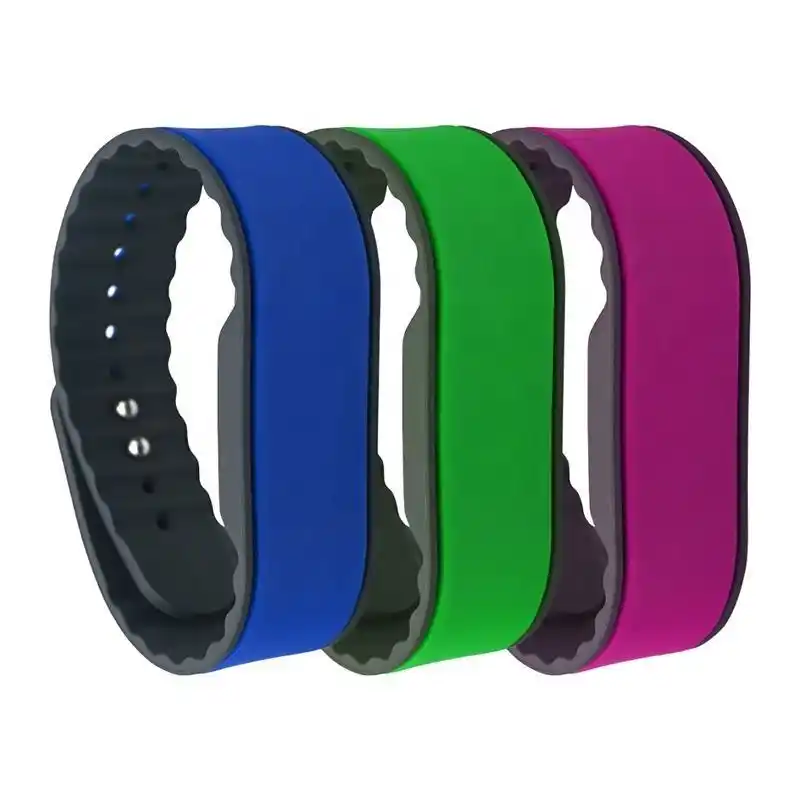
If you’ve ever run an event gate, a gym front desk, or a hospital check-in, you already know this truth: a wristband that “usually scans” will wreck your ops. One bad batch turns into slow lines, angry guests, and staff doing manual overrides all night.
So let’s talk about RFID wristband quality testing the way engineers and buyers actually need it. Not fluffy. Real lab tests, real failure modes, and how to write a spec that a factory can execute.
Also, I’ll pull in what we build at CXJ Smartcard (factory-direct OEM/ODM), because the best test plan depends on what you’re actually buying: silicone vs woven vs Tyvek, HF/NFC vs UHF, printed + encoded vs blank.
RFID Wristband Quality Testing
Read Range, Read Rate, and Orientation Sensitivity
First argument you should tattoo on your spec: don’t test “can it read”. Test how well it reads.
In the lab, ask for a setup that measures:
Read range (how far it still scans)
Read rate (how fast you get a reliable hit)
Orientation sensitivity (does it die when the wrist twists?)
On-body detuning (human water-bag effect is real, sorry)
Repeatability (same result across many bands, not one lucky sample)
Real-world scene: festival entry. People stack wrists, wave phones, hold beer. Your reader sees a “dense tag” mess. If your wristband only works at one angle, your line gets sticky fast.
Cross-Reads and Dense Tag Environments
Second argument: you must test cross-reads.
Cross-reads show up when:
People stand shoulder-to-shoulder at a gate.
Staff scan too wide (portal antenna too “hot”).
Bands sit close together in a box during encoding/verification.
So you test anti-collision performance and read zone control. In plain words: “Does the reader grab the correct wristband, right now?”
ISO/IEC 14443A, ISO/IEC 15693, and ISO 18000-6C (UHF)
HF/NFC 13.56 MHz and UHF 860–960 MHz
When buyers say “RFID wristband,” they might mean NFC or UHF. Those behave totally different.
CXJ Smartcard supports LF, HF/NFC (13.56 MHz), and UHF (860–960 MHz), and we typically match the chip + antenna to your reader environment.
Here’s the quick cheat sheet:
Frequency & standard keyword
Typical scan behavior
Where it feels “right”
Wristband gotcha
HF/NFC 13.56 MHz (ISO/IEC 14443A)
Tap, close-range
access control, cashless, membership
body/metal nearby still matters, but less drama
HF 13.56 MHz (ISO/IEC 15693)
Slightly longer range than tap
libraries, ID workflows, mid-range reads
reader tuning matters, don’t assume plug-n-play
UHF 860–960 MHz (ISO 18000-6C / EPC Gen2)
fast bulk reads, portals
logistics, retail counts, laundry tunnels
human body + water kills range if you pick wrong inlay
If you’re not sure which one you need, start from the workflow. Then pick the tech. That’s how you avoid buying a “perfect” wristband for the wrong system.
Tensile Strength and Peel Strength
Tensile Strength Test
Third argument: RFID performance isn’t the only thing that fails.
A wristband breaks long before the chip dies, especially in high-churn venues.
A standard lab approach uses a tensile tester to pull the band until:
the strap snaps,
the clasp fails,
or the embedded part pops out.
Scene: hospital or kids venue. People tug at bands all day. If your tensile strength is weak, you’ll re-issue bands nonstop. Staff will hate you, lol.
Peel Strength Test
If the wristband uses adhesive or a closure layer (common on disposable styles), do a peel strength test.
You’re answering: “Does the closure stay closed after sweat + motion?” Not romantic, but it saves weekends.
Water Resistance Test and Soak/Dry Cycle
Water Resistance Test
Fourth argument: water doesn’t just wet the band. It changes RF behavior and kills print.
A practical test plan includes:
water immersion,
light agitation,
then verify RFID reads and printed code readability (barcode/QR/text).
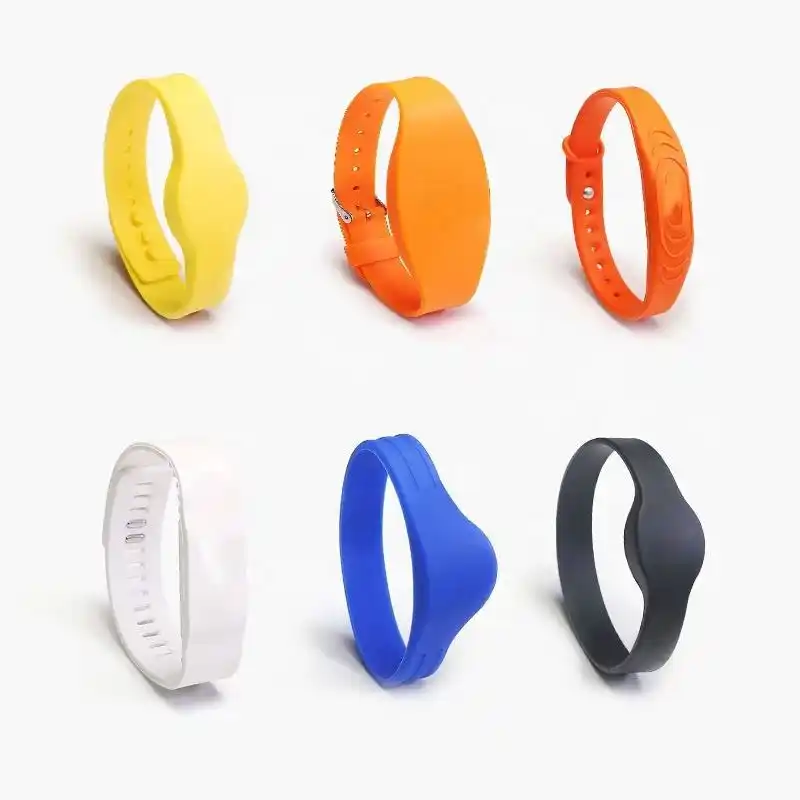
This matters for Tyvek and woven wristbands where print quality is part of the UX. CXJ’s wristband lineup includes silicone, woven fabric, Tyvek paper, PP synthetic paper, and PVC, so the correct water test depends on the material.
Soak/Dry Cycle
Single dunk tests are okay, but soak/dry cycles look more like real life:
sweat,
shower,
towel wipe,
repeat.
You’ll catch failures like delamination, faded print, and “it scanned yesterday but not today” issues.
ASTM D5264 Chemical Rub Test
Chemical Resistance and Print Durability
Fifth argument: chemicals are the silent killers.
Think:
alcohol wipes (medical),
sunscreen (outdoor festivals),
hand sanitizer (everywhere),
chlorine splash (water parks).
A chemical rub test (often referenced as ASTM D5264 style rub testing) simulates repeated wiping. You check:
print legibility (barcode/QR still scans),
surface coating wear,
and sometimes chip area sealing if it’s a composite build.
If you sell “cashless + ID + branding” in one band, this test pays for itself. It prevents the classic headache: RFID reads, but staff can’t visually verify anything.
IEC 60529 IP Rating
IP Code and Water/Dust Exposure
Sixth argument: only claim IP rating if you can test it.
Most wristbands don’t need an IP label printed on them. Still, some deployments do demand it, especially when the wristband includes a hard enclosure, clasp module, or a special embedded capsule.
If your customer says “we need waterproof,” ask:
What water exposure? rain, dunk, jets?
Any dust or sand?
Then map it to an IEC 60529 IP code test plan. Keep it simple. Write the condition. Test the condition.
ISO 4892-3 UV Weathering Test
UV Exposure and Color Fastness
Seventh argument: UV wrecks polymer bands and fades print.
Outdoor use cases:
multi-day festivals,
resorts,
marathons,
theme parks.
A UV weathering test (keyword: ISO 4892-3) helps you compare materials and inks. You’re checking:
cracking,
brittleness,
color shift,
and scannability after exposure.
Not every order needs this. If your wristband lives outdoors for days, it does.
ISO 2859-1 AQL Sampling Plan
AQL Sampling, Incoming Inspection, and Outgoing Inspection
Eighth argument: quality control isn’t vibes. It’s a sampling plan.
For large buys, write:
AQL sampling plan (keyword: ISO 2859-1),
defect categories (critical / major / minor),
what happens on failure (rework, sort, replace).
CXJ Smartcard also pushes ISO-based QC and 100% outgoing inspection as a default guardrail. That helps when you scale from pilot to mass production.
RFID NFC Bracelets and Product Categories
RFID Cards, NFC Tags, RFID Keyfobs, RFID Sticker Labels, RFID Wash Care Labels, RFID Laundry Tags, RFID NFC Inlay
Here’s the part many buyers miss: wristbands rarely ship alone. A real deployment often bundles other identifiers.
On CXJ Smartcard’s site, the product categories include RFID Cards, NFC Tags, RFID Keyfobs, RFID NFC Bracelets, RFID Sticker Labels, RFID Wash Care Labels, RFID Laundry Tags (PPS/Textile/Silicone), RFID NFC Inlay, Anti Metal ABS UHF RFID Tags, Patrol Tags, and Animal Glass Tube Tags.
Use this mapping when you build your test plan:
What you’re deploying
Common “bundle” items
Why buyers bundle it
Event access + cashless
wristbands + cards + NFC tags
staff badges, poster taps, VIP workflows
Hotels / resorts
wristbands + keyfobs + cards
lockers, room access, cashless pool bar
Retail / logistics
wristbands (staff) + UHF labels + anti-metal tags
portal reads, shelf counts, metal assets
Laundry tracking
laundry tags + wash care labels + inlays
sewing formats, heat-seal options, ERP mapping
If you want to browse the categories fast, these pages help:
(That’s your “one vendor, one data spec” play. Less finger-pointing when something scans weird.)
Standard Lab Tests Matrix
Here’s a clean table you can drop into a PO, a spec sheet, or a supplier audit doc.
Test keyword
What it catches
Pass criteria you can write (simple)
Read range / read rate
slow gates, weak scans
consistent reads at your target setup, low misses
Orientation sensitivity
“only reads when lucky”
reads across wrist angles, not just flat-on
Cross-read test (dense tags)
ghost reads, wrong ID
correct tag captured, low false positives
Tensile strength
strap breaks, re-issues
strap/clasp survives defined pull load
Peel strength
closure opens early
closure stays locked after pull/peel cycles
Water resistance
dead scans + smeared print
RFID + barcode/QR still works after immersion
Soak/dry cycle
day-2 failures
reads + print stable after repeated cycles
Chemical rub (ASTM D5264)
sanitizer/sunscreen damage
print remains scannable after rub cycles
UV weathering (ISO 4892-3)
fading + brittleness
color/strength within your tolerance window
AQL sampling (ISO 2859-1)
batch drift
lot acceptance rules are clear and enforceable
Yeah, it’s a lot. But once you set it up, you stop gambling on “factory promises”.
Custom RFID Manufacturer | OEM/ODM Cards, Tags & Wristbands
If you want these tests to actually happen, pick a supplier that can do end-to-end OEM/ODM: antenna/inlay, material choice, printing, and secure encoding under one roof.
CXJ Smartcard positions itself as factory-direct OEM/ODM with ISO-based processes, material compliance options, and outgoing inspection.
My practical tip: ask for free samples and test reports, then run a small pilot in your real reader environment. If the pilot feels smooth, scaling gets way less scary.